July 2026 · 5 min read
Template website or custom website: what you really get for your money
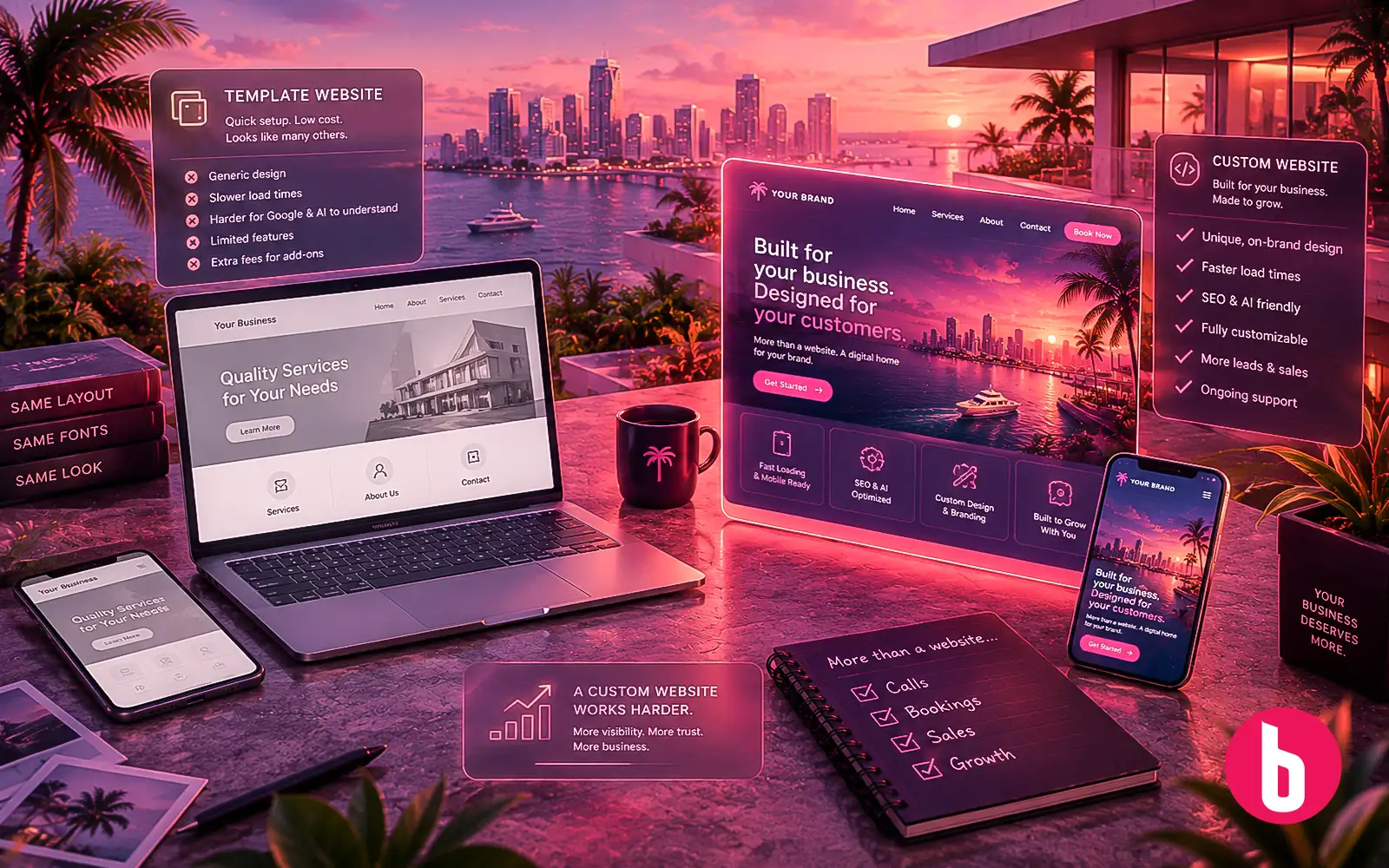
A template website is a ready-made design you fill in with your own words and photos. A custom website is designed from scratch around your business, your customers and your goals. Templates cost less up front, but they can load slower, look like many other sites and be harder for Google and AI to understand. A custom website costs more at the start because it is built to work harder for your business every single day.
“Why would I pay for a custom website when I can get a template for $39 a month?” I hear this question a lot and it is a fair one. If all you need is a page that says your business exists, a template can do that.
But most owners do not want a website that just exists. They want one that brings in calls, bookings and sales. That is where the difference between a template and a custom website starts to show.
What a template really is
A template is a ready-made design that many other businesses already use. You pick one, swap in your logo, your text and your photos and you can be online the same afternoon. That speed is the appeal.
The catch is that the design was made for no one in particular. Your bakery, a law firm in Coral Gables and a yoga studio in Miami Beach could all be using the same layout with different photos. Your website looks fine, but it does not look like you. And when a customer is comparing three businesses side by side, “fine” is easy to forget.
The hidden cost of “cheap”
The monthly price of a template is easy to see. What is harder to see is the business it never brings in. A website that looks like everyone else gives customers no reason to remember you. A website that loads slowly loses people before they read a word. And a website Google and AI cannot understand is one they rarely recommend.
Then come the add-ons. Many template platforms charge extra for the things a growing business needs, like bookings, online payments, more pages or removing their own branding. Over a few years, “cheap” can quietly add up.
Speed is where templates quietly cost you
Templates are made to fit everyone, so they carry a lot of extra weight most businesses never use. All of that takes time to load and every second counts. One of the biggest media companies in the world measured it on its own websites: it lost an additional 10% of visitors for every extra second a page took to load.
Visitors waiting for a page to load
Think about what that means for a local business. Someone searches for you on their phone, taps your site and waits. One second. Two. Three. Many never see your homepage. They tap back and call the next name on the list.
What custom really means
A custom website starts with your business, not with a layout. Before we design anything at Bizsual, we study your market, your customers and the businesses they compare you with. Then every page is designed around what your customers need to see to choose you.
Custom also means the site carries only what your business needs. Nothing extra slowing it down. That is how a custom website can open in the blink of an eye, even on a phone with a weak signal in the parking lot.
Think of it like a suit. A template is the one on the rack: it fits most people well enough. A custom website is tailored to your business, your customers and the way you sell. It shows.
And it is made to be understood. Google and AI assistants need to know exactly who you are, where you work and what you offer. A custom website is designed with that in mind from the very first page, instead of hoping a template got it right.
What speed is worth
Big companies have measured what a faster website is worth to them. When Vodafone made its pages load faster, it sold 8% more. When Rakuten 24 sped up its site, the share of visitors who bought something grew 33%. The Economic Times saw 43% fewer visitors leave right away. Those are big brands, but the lesson is the same for a local shop: a faster website keeps more people around long enough to choose you.
What a faster website did for big brands
What you really get for your money
- Design: a template looks like many other websites. A custom website looks like your business and nobody else.
- Speed: a template carries extra weight for everyone. A custom website carries only what you need.
- Google and AI: a template gives every business the same structure. A custom website is designed so Google and AI clearly understand who you are, where you work and what you offer.
- Growth: a template locks you into its layout. A custom website grows with new pages, services and locations as your business grows.
When a template is enough
I will be honest with you. If you are testing a new idea or you need something online this week, a template is fine. But once your website is supposed to bring in customers, it becomes your hardest working employee. You want that employee trained for your business, not for everyone’s.
Lots of businesses start with a template and that is often the right call at the time. The moment to move on is when you notice the website is not pulling its weight: few calls, few bookings and few customers who say they found you online.
The bottom line
A template gets you online. A custom website gets you chosen. The real question is not which one costs less this month, but which one brings in more business every month after that.
At Bizsual every website is designed from scratch, built to load fast and made to be read, cited and recommended by AI. If your website is not bringing you calls yet, let’s talk about what a custom one could do for your business.
Jose Perdomo III
Creative Director, Bizsual. Manifesto